
Entropion in the
Cavalier King Charles Spaniel
-
 What
It Is
What
It Is - Symptoms
- Treatment
- Breeders' Responsibilities
- What You Can Do
- Related Links
- Veterinary Resources
Cavalier King Charles spaniels have a relatively high incidence of entropion, according to the American College of Veterinary Ophthalmologists (ACVO).* It usually develops within a few months of birth. Studies have concluded that brachycephalic dogs may be predisposed to this condition.
* See also, Ophthalmic Disease in Veterinary Medicine and this 2022 book.
What It Is
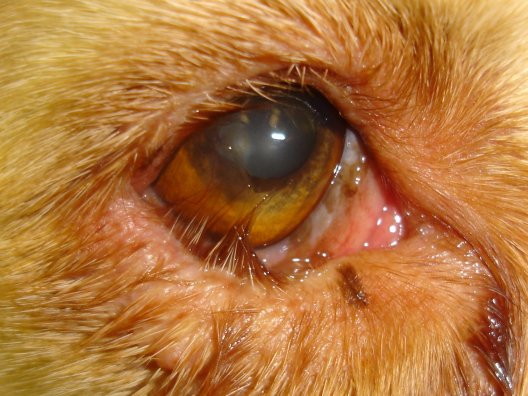
Entropion (entropium) is an inward rolling of the eyelid edges, causing the lashes to rub against the eye's conjunctiva and cornea. It most often affects the lower eyelid of one or both eyes. The hair on the affected lid continuously rubs against the cornea and can cause significant discomfort and trauma to the conjunctiva and cornea. (See photo above.) It is a painful and potentially blinding inherited disease.
RETURN TO TOP
Symptoms
When the eyelashes come in contact with the conjunctiva or cornea, they will cause chronic irritation, resulting in various degrees of abnormal contractions or twitches of the eyelid (blepharospasm), excessive tearing (epiphora), inflammation (conjunctivitis; keratitis), ulceration, blepharitis, and infection.
The irriation can cause the dog to keep the affected eye closed, or to involuntarily blink constantly. The eye may appear red and sore from the inflammation. The dog may paw at or rub its eyes, and otherwise whine and appear agitated.
The symptoms are very similar to a more serious optical disorder, ectopic cilia, in which one or more eyelashes protrude through the inside of the eye, causing similar injury to the affected eyes.
RETURN TO TOP
 Diagnosis
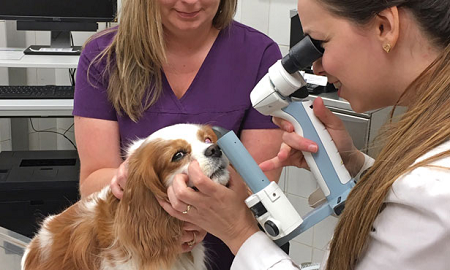
During a thorough eye examination, the emphasis will be on focal illumination and magnification using a slit-lamp bio microscope (see photo at right), to identify and locate the positions of the lashes.
Because the distichia may have damaged the conjunctiva and/or cornea, the ophthalmologist must also diagnose any resulting disorders, such as conjunctivitis, ulceration, blepharitis, and/or infection.
RETURN TO TOP
Treatment
Entropion cannot be corrected by medical therapy, apart from medication for resulting corneal ulcers.
Surgical correction is always necessary. Based on the severity of the entropion and age of the cavalier, different surgical techniques may be used. A very successful surgical combination technique for the correction of lateral lower lid entropion involves a combination of Hotz-Celsus and lateral eyelid wedge resection procedures. The overall success rate for a single surgical procedure to correct lower lid entropion with this technique was 94.2% per eye. See this Januaary 2007 article.
RETURN TO TOP
Breeders' Responsibilities
The Canine Eye Registration Foundation (CERF) advises that entropion is a
painful and potentially blinding disease and therefore affected dogs in several
breeds which have a higher incidence of entropion than do cavaliers are denied
certification. Currently, CERF does not deny certification to cavalier King
Charles spaniels
 which are affected with entropion, because the Genetics
Committee of the ACVO classifies the disorder as a "breeder option" for CKCSs.
See
The Blue Book.
which are affected with entropion, because the Genetics
Committee of the ACVO classifies the disorder as a "breeder option" for CKCSs.
See
The Blue Book.
The Cavalier King Charles Spaniel Club, USA recommends that, prior to breeding any cavalier, the dog have a normal rating or be within CERF "breeder options" from a screening by a board certified veterinary ophthalmologist.
However, cavaliers affected with entropion should not be bred to each other. Any littermates of breeding stock having entropion should be taken into consideration. All cavalier breeding stock should be examined by board certified veterinary ophthalmologists to determine if the dogs are affected with entropion.
The Canine Health Information Center (CHIC) is a centralized canine health database sponsored by the AKC/Canine Health Foundation (AKC/CHF) and OFA. The CHIC, working with participating parent clubs, provides a resource for breeders and owners of purebred dogs to research and maintain information on the health issues prevalent in specific breeds.
AKC's national breed clubs establish the breed specific testing protocols. Dogs complying with the breed specific testing requirements are issued CHIC numbers. The ACKCSC requires that, to qualify for CHIC certification, cavaliers must have a CERF eye examination, recommending that an initial CERF exam be performed at 8 to 12 weeks, with a follow up exam once the dog reaches 12 months, and annual exams thereafter until age 5 years, and every other year until age 9 years. However, all that is required to qualify for a CHIC certificate is that the breeding stock be examined by a veterinary ophthalmologist. It does not require that the results of the examination show no eye disorders.
RETURN TO TOP
 What You Can Do:
All CKCSs should be examined at least annually by a board certified veterinary ophthalmologist. They are listed on the website of the ACVO.
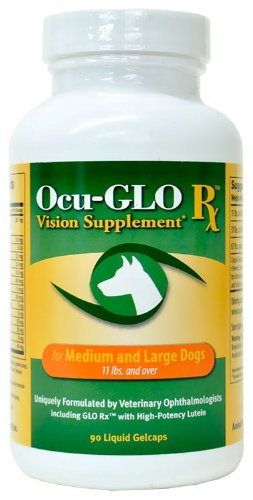
Ocu-GLO Rx is a nutraceutical containing several natural antioxidants in a combination blend formulated specifically for canine eye health. Many veterinary ophthalmologists recommend this product to maintain healthy eyes. Even if your dog has not been diagnosed with a vision disorder, antioxidants contained in Ocu-GLO Rx are considered helpful in keeping dogs' eyes healthy.
RETURN TO TOP
Related Links
RETURN TO TOP
Veterinary Resources
Ocular Disorders Presumed to be Inherited in Purebred Dogs. A.C.V.O. 1999.
Control of Canine Genetic Diseases. Padgett, G.A., Howell Book House 1998, pp. 198-199, 240.
Guide to Congenital and Heritable Disorders in Dogs. Dodds WJ, Hall S, Inks K, A.V.A.R., Jan 2004, Section II(103).
Breed Predispositions to Disease in Dogs & Cats. Alex Gough, Alison Thomas. 2004; Blackwell Publ. 44-45.
Ophthalmic Disease in Veterinary Medicine. Martin C.L. Manson Publ. 2005.
Entropion correction in dogs and cats using a combination Hotz-Celsus and lateral eyelid wedge resection: results in 311 eyes. Robert A. Read, Hugh C. Broun. Vet. Ophthal. January 2007;10(1):6-11. Quote: A novel surgical combination technique for the correction of lateral lower lid entropion in dogs and cats is described, involving a combination of Hotz-Celsus and lateral eyelid wedge resection procedures. The technique was used to treat 311 eyes with lower lid entropion: 269 canine (109 bilateral, 51 unilateral) and 42 feline (16 bilateral, 10 unilateral). The most common canine breeds were the Shar Pei, Rottweiler, Bull Mastiff and Labrador Retriever. Domestic cats made up the majority of feline cases. The overall success rate for a single surgical procedure to correct lower lid entropion with this technique was 94.2% per eye.
Ophthalmic Disease in Veterinary Medicine. Charles L. Martin. Manson Publ. 2009; page 475, table 15.1. Quote: "Presumed Inherited Ocular Diseases: Table 15.1: Breed predisposition to eye disease in dogs: Cavalier King Charles Spaniel: ... Entropion".
Breed Predispositions to Disease in Dogs & Cats (2d Ed.). Alex Gough, Alison Thomas. 2010; Blackwell Publ. 53.
Ocular Disorders Presumed to be inherited in purebred dogs. Genetics Committee of the American College of Veterinary Ophthalmologists. Blue Book 6th Ed. 2013. pp. 241-247. Quote: "Cavalier King Charles Spaniel: Disorder: C. Entropion. Inheritance: Not defined."
Essentials of Veterinary Ophthalmology (4th ed.). Gelatt, Kirk N.; Plummer, Caryn E. Wiley-Blackwell. 2022. Quote: Specific breeds demonstrate entropion often affecting the same sites. ... Medial lower lid: ... Cavalier King Charles Spaniel.
The Blue Book. Ocular Disorders Presumed to be inherited in purebred dogs. Genetics Committee of the American College of Veterinary Ophthalmologists. Blue Book 15th Ed. 2023. pp. 297-302.
CONNECT WITH US